
BANDO
Bando, or Bandojei, belongs to the Dununba group of rhythms and originates from Takoura in Upper Guinea. Bando is the name of a certain race of monkey with a white tail, and Jei means “tail”.
When a Bando is frightened by hunters aiming at it, it shakes its tail. When it dies, it urinates on its tail, which changes the white color and allows the hunters to confirm its death.
For this rhythm the dancers wear a type of neacklace upon which is fixed a white tuft symbolizing the tail of the monkey. They shake it by shrugging their shoulders up and down rapidly.
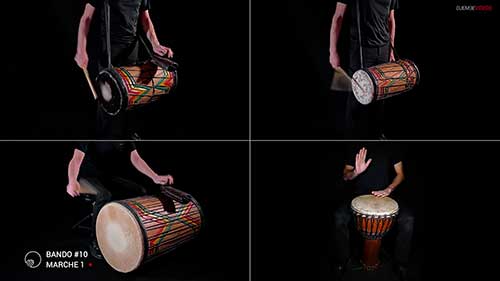
Bando starts with an introduction (“marche” in French) announcing the arrival of the dancers who are adept in this particular dance. As they arrive, the Barati perform acrobatic figures. Once the dancers are in place the sangban plays its “sortie” and the Bando rhythm starts. At this point in time the dancers start the Bando dance. The steps are synchronized with the dancers forming a line, one in front of the other.
Read more
In a Dununba sequence, the “marche” is used as a transitional passage between the preceding rhythm and the basic Bando rhythm.
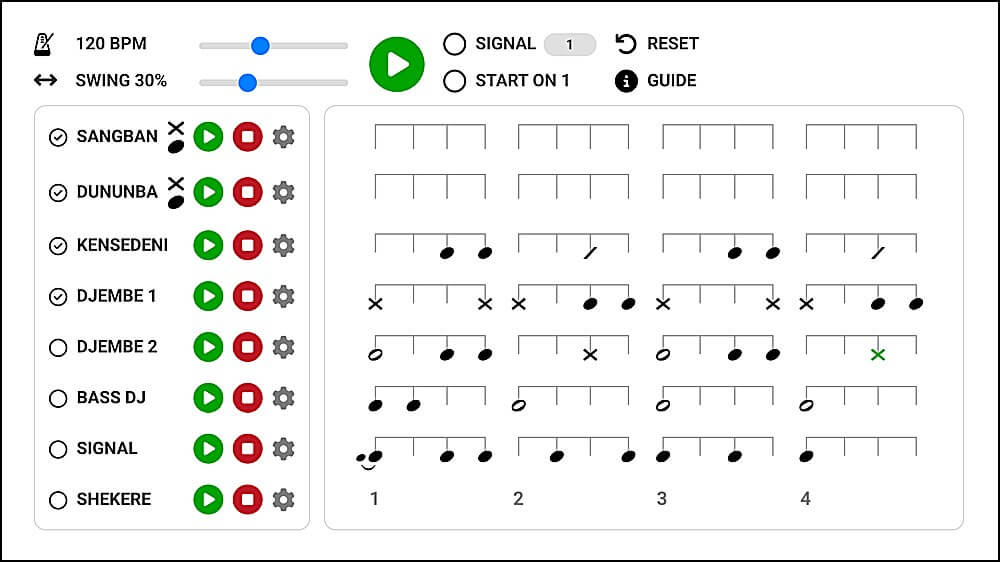
The Bando dancers depend on the kensedeni, i.e. they consider that the beat of the music is on the 1st and 3rd slap of the kensedeni (3rd eighth note of each beat). The same rule applies for the djembe solo patterns that accompany the dance.
DUNUNBA
Dununba, whose name is taken from the biggest dunun (Ba means “big”), refers to an important Malinke festival, as well as the rhythms and the notorious traditional dance for men, also known as the “Dance of the Strong Men”.
Originally from the Hamana and Gberedu regions (divided by the Niandan river) in Upper-Guinea, the Dununba festivals have two traditional functions : 1. the transition between different age groups. 2. the settlement of personal conflicts. The regular occurrence of these festivals also provides entertainment for the population.
During the Dununba festivals (generally held during the dry season, from October to June), the social hierarchy is reorganized or left unchanged. The participants show their courage and strength by dancing and provoking one another.
The larger Dununba festivals are organised on the bara, the public square and dance area that all villages have. In recent times, smaller festivals can be held in different locations for different occasions.
There is a tall, century-old tree, in the center of the bara, around which circles are formed. These circles are made up of specific age groups (the karé). Depending on the occasion and size of the village there can be a total of ten to fifty dancers.
The barati (or baratigui, the masters of the bara) are the strongest and eldest men, reponsible for the Dununba festival and dominate the proceedings on the dance square.
Aged between 25 and 27, they constitute the working essence of the village (farming, manual labour, general upkeep of the village, law protection…) and organize all types of festivals held on the bara.
At the age of 27 to 28 they are relieved of their barati duties (similar to military service) and therefore dedicate themselves to normal family life.
The barati are dressed in large black trousers with white embroidery (dua), a scarf tied around their heads (basatimbadaba, meaning “the front of the lizard’s head”). They hold in their right hand a decorated axe (gendé or gendéni) and in the left a whip made of hippopotamus or warthog leather (manimfosson).
The baradömö or baramakönö (meaning “the one who waits” to become a barati), the little brothers, are the preceding age group to the barati, followed by the baramamaré (grandsons). They wear a scarf called dunundondjala (“scarf for the dance”). The youngest of all and at the bottom of the social ladder are the Baramakönö.
Each of the age groups (more specifically, an age category—a group of young people raised together) has its own leader. This community of dancers is refered to as the barati.
Below are the different generations in the Hamana/Gberedu region:
1 – Barati
2 – Baradömö (or Baramakono)
3 – Baramamare
4 – Kondenba
5 – Kondenden
6 – Timbaraba
7 – Konkoson
8 – Nanfadimani
9 – Sulukuni
Behind the musicians are the well-dressed and beautiful young girls who encourage the dancers by singing and clapping. Generally there are several griottes (djéli muso) present who sing and play the karignan (metal tube with grooves. This is played by running a metal rod back and forth on the grooves).
It is in this conventional dance that the hierarchy is exposed between the different age groups (karé). Also the settling of personal conflicts occurs. This was sometimes violent (including flogging) but today it has become rare.
In the past it has come about that the dancers are badly injured and even killed. Should the latter occur the music is stopped immediately and every one is informed of the incident on the bara.
The men who desire the title barati must challenge the men who already hold that rank to a combat during a Dununba festival. When the challengers win they earn their title of barati. Furthermore, when a barati becomes too old, a ceremony is organised during which he becomes “barati d’honneur”.
The festival progresses in different parts, each of which is accompanied by one of the Dununba rhythms. There are collective, individual and mixed dances (mixed being of different ages and different sexes – occasionaly the girls join the man of their choice on the bara: this is an unspoken rule that unites two people).
The differents Dununba rhythms are played uninterrupted throughout the festival.
Dununba festival unfolds
In the morning, the drummers regroup in front of the hut (tibun) where the instruments are stored. In Baro, this hut is located in the Camara family’s property which is otherwise known as Camarala. They briefly play the rhythm Kon three or four times, which tells the population that a dununba festival will happen in the afternoon.
In the afternoon, the musicians start again from the tibun by playing the rhythm Kon, calmly and without variations. After a few minuts they walk towards the bara whilst playing Baradatadunun (meaning “the drums go to the square”). This rhythm varies from village to village.
The rhythm serves as a signal for the dancers and single girls to meet at the bara. Upon hearing the music all in the local vicinity are aware that the festival is beginning.
None of the habitants can remain indifferent to the call of the Kon, regardless of their age. If the women who are to accompany the musicians with the singing and clapping do not attend they are punished.
Once they arrive at the bara the musicians stop playing the rhythm until everyone is present. After which the sangban and kensedeni start to play Kon slowly, then this is followed by the energetic entrance of the dununba.
On some occasions the musicians begin playing directly on the bara.
At the beginning of Kon, young boys aged between 6 and 12 dance, then are chased with whips or branches when the barati arrive. A group “chauffe” for the dancers signals the opening of the festival.
The barati start opposite the drummers in tight rows, in lines of two to four people, and move towards them several times, with big steps, in a very impressive way. At the sangban signal (“sortie”), they stop and move their axe towards the ground.
Then they start the circle by marking their space on the bara.
The baradömö and the baramamaré form a second circle. They show spectacular dance steps and acrobatics and provoke the barati. Formerly, they showed them their backs to the barati and received violent whippings in order to show their courage and their resistance to pain, this in order to prove that they were worthy of becoming barati.
The dancers alternate between “pas de marche” (strutting) and “chauffes”, be it individually or as a group. The four karé dance separatly, the barati being on the outside of the circle.
When two groups meet they both wish to take the outer dominant circle. The men of the superior age group block the passage by agressively waving their axes and whips. To change the karé, the young men must repeatedly show their acts of courage.
For the duration of the festival the bonkélénabila (the chief barati, the strongest of all the men) dances around the bara in the opposite direction wearing a basatimbadaba, a monkey skin, calabash rings around the biceps (also called Kon), and an enourmous pipe in his mouth. He has the authority to do as he wishes furthermore no one is allowed to dance with him. He is a very important character, the regulator in charge of enforcing a certain order in the Dununba ceremony.
Throughout the festival horns are regularly blown.
The sequence of Dununba rhythms ends with Gbada, during which the intensity reaches its climax. The barati walk quickly taking large steps around the bara. The confrontation between the groups brandishing their axes and whips intensifies until the inevitable confrontation (it becomes obvious which of them are the strongest men).
Finally the sangban drummer (sangbanfola) plays an ending pattern (Gbadaladji, meaning “take down de Gbada”), followed by the dununba. The tempo slows down until the music stops. The dancers reunite in front of the drummers and decide whether they have had enough or if the festival is to continue. If they decide to continue the sangbanfola again starts Kon.
At the end of the festival the crowd disperses. The drummers then return to the hut where the instruments are stored whilst playing Lumatadunun (“back to home”). Like Baradatadunun, this rhythm varies from village to village. The return voyage to the hut can be followed by young boys and girls. Once at the hut the music may continue in a more relaxed atmosphere.
The Dununba legend
In the 12th century, Imouraba Keïta, Soundiata Keïta’s nephew (founder of the Mandingo Empire) moved to the little village called Kouroussa where he prospered and eventually created the Hamana region.
One day some of the prince’s young admirers decided to organise a festival in his honour. The village guardian spirits (“génies”) who are invisible and considered superior offered a never before seen dance, the Dununba.
The “génies” sent their children to demonstrate this dance who likewise wished to remain invisible. The villagers could only see the instruments and the dance steps (only the dancers’ legs were visible). They demanded that the prince Imouraba Keïta implore the gods. He did so and joined the dancers thus revealing the “Dance of the strong men”.
The “Mare” festival (Dahlamon)
It’s in the village of Baro that it all began, seemingly in 1239. Close to Baro is a pond (“mare” in French) called Bolé. Bolé is a sacred place as is the wood (or “sacred forest”) which is situated between the village and the pond.
The elders believe in the kindness of the “génies”, Bolé Karinkan and Bolé Fadima who live in the forest : in fact most of the wishes made in this area have been granted for over seven centuries.
Thousands of people come to the Baro festival to implore the favour of the “génies”.
The “Mare” Festival is held every year in May, not only in Baro but also in other villages (Babila and Koumana who own the Nantamba pond ; Kourala and Balato who own the Walibé pond and Noukounkan the Noukou pond…). The village elders choose the date of the festival at the end of the dry season by studying nature’s indications.
This festival celebrates the pond as a fertility source (this manifestation signals the return of the rainy season). In fact, in the beginning, the “génies” were summoned only by woman in wedlock who are unable to bear children. Then the requests spread to other domains such as healing, professional success and social prowess…).
The festival also gives the opportunity for the village habitants who left to return to the get-together.
During the “Mare” festival there is a fishing ritual to guarantee the prosperity of the village. During the rainy season (from June to August), the river breaks its banks and floods the surrounding area including the ponds. At this time the ponds are filled with young fish. As the dry season approaches its final days (in May) the water level is at its lowest and the fish are big enough to be removed.
The principal “Mare” Festival is held in Baro for a duration of three days.
The ceremony attracts Guineans from all over the country including artists (musicians, dancers, acrobats, magicians…), upper classes, traders, pilgrims, government officials and also foreign tourists.
The first day is used to prepare and clean the forest and the bara. On this occasion the rhythms played are from the Kassa group of rhythms (Soro, Dibon, Konkoba…) and Kurabadon the sacred forest rhythm.
On the second day a large reception is organized on the football field in the honour of the culture minister. The artists are invited to attend.
On the third day a big Dununba festival begins in the morning. Approximately one hundred barati come from all over to defend their village’s honour.
After that, a ceremony is conducted in the sacred forest to honour the spirits of Karinkan and Fadima. The festival is closed by fishing. The pond guardian gives a sign and everybody rushes into the water carrying a fishing net, spear, calabash or a basket.
The ceremonies have become so polular that the government now promotes and also protects the sacred sites.
The music
The Dununba rhythms are powerful. This is reinforced by the dances and the different significations of the ritual festival.
The sangbanfola and the djembe soloist hold a major role and maintain a tight relationship with the dance. The sangban pattern is at the heart of each rhythm. In a Dununba festival the sangban controls the rhythms sequence and plays in conjunction with the dance.
As for the dununba, it complements the sangban patterns and emphasizes its notes with both instruments being in tight collaboration.
The dununba slightly accentuates the notes which it has in common with the sangban.
The dununbafola must always pay close attention to what the sangbanfola is playing and fill in its patterns as per the defined repertoire.
It is essential for both of the musicians to master their communal variations to guarantee a perfect rhythmic harmony between sangban and dununba.
Finally the kensedeni pattern and the djembe accompaniments are identical in all of the Dununba rhythms.
These rhythms are never played very fast. The tempo can increase slightly during the “chauffes” but the music intensifies rather than accelerating.
The Dununba rhythms are also played outside of the ceremonies and the bara in a less formal manner : they are then called Dunungbé (gbé meaning white).
The Dununba group of rhythms is in constant evolution with numerous rhythms being created regularly.
Although originally from the Hamana region, the Dununba are also popular in Kankan, Faranah, Siguiri… They are widely diffused throughout West Africa in various forms and open to both men and women.
It’s in the Gberedu that these rhythms have remained in their purest forms.
BASIC PATTERNS
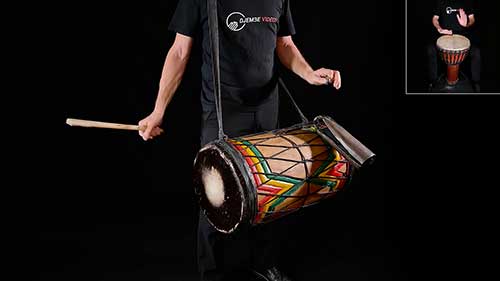
Sangban
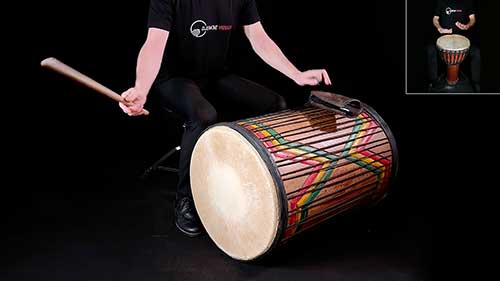
Dununba
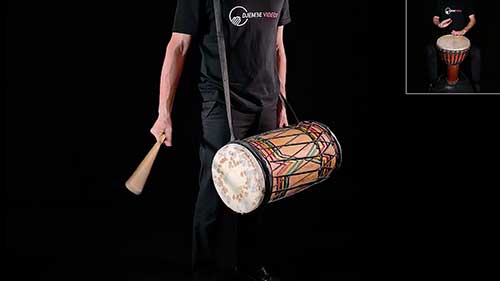
Kensedeni
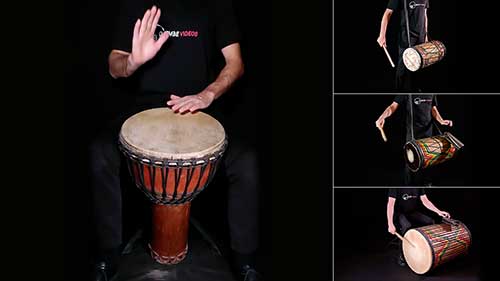
Djembé (4)
Marches (5)
LOOPS
VARIATIONS
Sangban (60)
Dununba (47)
CHAUFFES
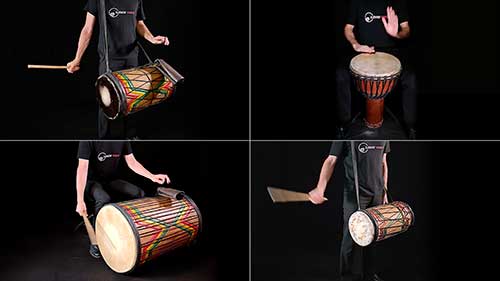
Dununs (16)
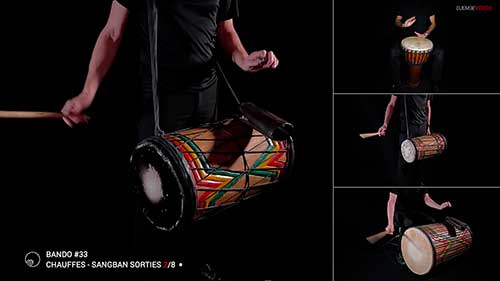
Sorties (8)
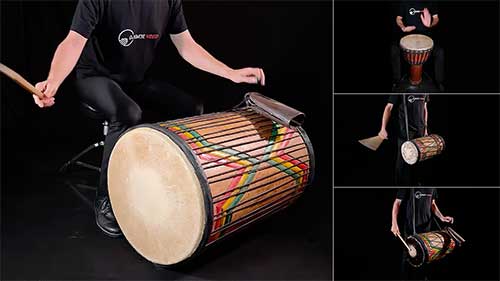
Dununba (6)